
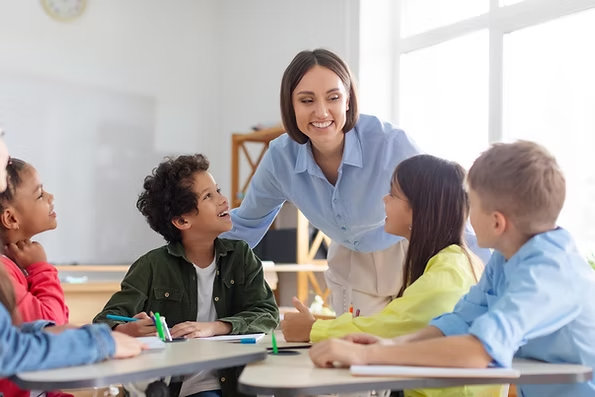
With the amount of time students spend in school, it’s no surprise they can form close bonds with their teachers. With these kinds of bonds, students enjoy their time in class more, teachers find greater fulfillment, and the school benefits from a more positive climate. However, some challenges can arise in the classroom as teachers must set boundaries with their students to keep classes on track and relationships professional.
A teacher’s job is to teach their curriculum’s material, but they can represent a lot more in a student’s life than just that. With the right actions, a teacher can become a safe space where students feel comfortable and seen. Physics teacher Cody Fults accomplishes this by treating his students as he thinks anyone would want to be treated.
“It goes back to my teaching philosophy. I honestly just treat my students like they’re human beings, that they have lives outside of my classroom. I know that many of them may face obstacles and challenges that I’ve never even faced as an adult,” Fults said. “I always like to also ask about interests during class. I have a lot of students who are in the fine arts, theater. It’s just showing that genuine interest in what they do and who they are as a person that helps do that [form bonds].”
By engaging in their lives, teachers can make their students feel seen, heard, and appreciated in ways they may not experience in the rest of school. Not only does this help students, but it also helps the classroom attitude. Fults believes having a good relationship with your students makes class time easier.
“Hopefully, [I affect them] in a positive way. I think if you have a positive relationship, it creates positive vibes. I have had a lot of students who will not work for other teachers who will work for me because they know I care, and I also give them time to be themselves, and a lot of them appreciate that,” Fults said. “Sometimes we’ll get off topic and we’ll be talking about really random things or current events or video games. I don’t have the same issues with discipline. I also view it differently, and so when a student knows that I genuinely care about them and we have a good relationship, I don’t usually have issues. So it helps, honestly, to allow the class to work for better or for worse.”
This is not the only way teachers are affected by the good relationship they form with their students. There is also an emotional aspect. Fults is more fulfilled with his job because of these bonds.
“It gives me purpose. I think teaching is not a profession a lot of people go into to make the money. The traditional saying is, ‘I’m not here for the income, I’m here for the outcome,’ and I think that holds true because I have the opportunity to not only work with my students, but I also get to see the people they become, and help foster and grow that,” Fults said. “There are a number of students that I still have relationships with outside the classroom. I’ve been to weddings. I’ve been to birthday parties. Normally during our breaks, like Christmas and Thanksgiving, I got to go have lunch with a lot of them, and just seeing all that potential they had turned into something and be molded is awesome.”
Administrators also benefit from being appreciated by the student body. Positive relationships help make communication easier between staff and students, which improves the school experience for everybody. Academic Associate Principal Shira Fuller is glad she’s known as a trustworthy adult.
“They know they can come and tell me when something’s wrong, and I think that they’re comfortable being very candid. But I think as an administrator, the most important thing is to be to be known as approachable, because that means someone who I’ve never spoken to before, and maybe never even seen, they’re comfortable approaching me with a problem,” Fuller said. “An administrator is one of the most important jobs to not just be able to build relationships, but have that sense of trust and safety, and not just with the students, but also with the teachers. So I hope that I’ve built a reputation as someone who’s safe to go to whenever you have to.”
Counselors are another group who gain from having close bonds with students. With the imperative role they play in student futures and mental health, it’s easy to see why they value relationships with their students. Counselor and former math teacher Kaitlin McCool believes being a safe space is a necessity when you work with young people.
“Just being there and being a safe space for students is really important, because a lot of students don’t have that outside of school. A lot of students have a less than ideal home situation, and they don’t feel as safe to talk to adults, and so being a safe adult at school gives them that opportunity to reach out if something’s wrong or if they’re in danger. And I did find myself in that situation quite a few times while I was teaching, and still do, especially as a counselor. That’s kind of more what you run into than counseling, I would say,” McCool said.
Overall, students benefit greatly from favorable relationships with staff members at school. They feel safer and more comfortable in a place where they lack authoritative power. Fuller has noticed this positive trend increase through school surveys.
“Every year, in the spring, the students and the teachers and the parents complete what we call climate surveys, and they’re a list of statements, and you say, ‘I agree with that statement,’ or, ‘I don’t,’ and the questions that specifically have to do with things like, ‘I feel safe,’ and ‘I feel like at least one adult on campus cares about me,’ We’re seeing those scores, those survey results, go up as we’ve continued,” Fuller said. “We just placed a really high value on people’s need to feel welcome, especially kids, because teachers are in a position of authority, and so even the boldest kid isn’t necessarily going to feel comfortable advocating for themselves in certain situations.”
Despite all the positives of students and teachers bonding, there has to be limits to keep the relationship professional. These boundaries show staff members in how, and how not, to interact with students. Advanced English I teacher Amy Markan believes that boundaries are important to avoid negative impacts from those bonds
“There has to be healthy boundaries always, but I think most of us that are in education are in education because we have kids, and we love all of our students like they’re our own kids. I mean, I used to tell students all the time I love you guys like my kids. So I don’t think there are negatives when it’s done the right way, with boundaries,” Markan said.
Many students are also aware of these boundaries and try to personally follow them. Junior Maliyah Williams denotes the difference between students and teachers and their difference in authority.
“Teachers probably shouldn’t be too casual with their students. Teachers really aren’t like your ‘friend’ friend, like your best friend. They’re still adults and they’re still people with authority,” Williams said.
Balancing authoritative power and relationships with students can be difficult for staff members, especially when they have to give discipline to a student they care about. Assistant Principal Derek Odelusi makes sure the students he talks to know he cares about them outside of disciplinary action.
“The boundaries we have are, ‘We can establish rapport, but there still is a respect for roles in terms of the student is a student and the teacher or the staff member is a staff member.’ It never should be sacrificed because of this and that. With all my students, I try to develop a rapport, but they still respect my role,” Odelusi said. “If they’re in the office and they skipped a class, now I’m having to follow through with a detention and issue the discipline, but when it’s all said and done, I’m still going to ask them, ‘Hey, how’d your competition go last week?’ Or, ‘Where’d y’all go on vacation?’ I let them know that our relationship doesn’t boil down to whatever it is you originally needed me for. I’m still concerned about you as a person.”
These boundaries can also present personal challenges for teachers as they must fill in their role as an authority figure. McCool used to struggle with her emotions as she exercised her authority as a teacher.
“When you’re a first year teacher, you’re figuring things out, and you just don’t always know how to handle a situation. Especially, I remember getting my feelings hurt so badly when I felt like the whole class was mad at me. That’s something that as a young teacher, you take that to heart. You’re like, ‘Oh, I don’t want my students to be upset with me’ but then you kind of grow out of that, and the longer you teach, you just realize it’s really necessary to be the bad guy sometimes, and that’s okay, and your students are going to forgive you, and they’ll be better for it in the end,” McCool said.
Even with these challenges, it’s important for teachers to make an effort to welcome all their students as it can have a big impact on them with how often they interact. Sophomore Maya Morisano has been especially helped by Karyn Myers, the choir director.
“I feel like every time that there’s a problem, like academically or just in general, like a personal problem, I can always go to Mrs. Myers, and she’s helped me through so many problems. She definitely makes choir really fun. I love the way she teaches and all of that. I feel like teachers and students should have a really good relationship, like they see each other every single day. I feel like a good relationship can help students improve academically,” Morisano said.
Students and teachers bonding goes beyond the immediate effect it has on the school. It affects who they are and become. Fuller maintains that education is a special career that is more than instructing young people.
“I’m no good at math, but let’s say I just love math, but teaching math just for the love of math is not going to fill up my cup. Seeing people grow and feeling like I’m successful in helping them be successful, that’s going to fill my cup up. And for a lot of teachers, it gives them a huge sense of purpose in education, there are a few careers out there where, and education is one of them. This isn’t what we do, it’s who we are. It’s a big part of our identity,” Fuller said.
The bonds students and teachers form with each other are impactful, not just to them, but to the administration and the wider school culture. School days can be easier to get through, incidents can be easier to report, and classroom instructions can be easier to follow. This puts an extra importance on keeping these relationships respectful so school can remain an enjoyable place for everyone.