
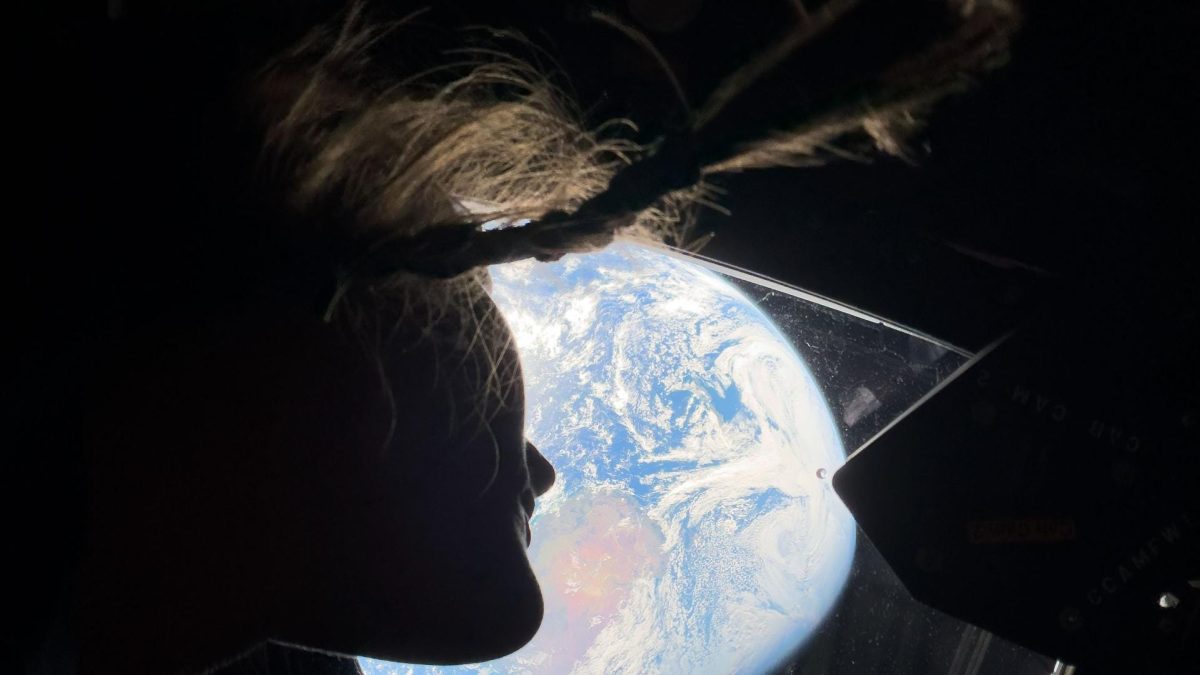
From the launch on April 1st, around the dark side of the moon, and back to Earth on April 11th, the Artemis II spacecraft has been further out in space than any manned spacecraft before it, with the four crew members becoming the first humans to ever see the dark side of the moon. This mission resulted in never before seen angles of the moon, new data collected, and a plan set for a moon landing mission in 2028.
Artemis II is just one step of the Artemis mission, which started with Artemis I in 2022. This mission aims to put humans back on the moon, leaving a long legacy behind as it does so. Astronomy teacher Jennifer Faulkner finds this legacy and its history meaningful.
“I have been following the Artemis missions since before they were even really called Artemis missions. They were starting to design the capsule as a part of the journey to Mars, so I have gone to see the capsule tested before. I’ve gone to go see the rocket engines at the John C. Stennis Space Center tested before, and I saw Artemis I launch. So it’s special just to get to see [Artemis II launch],” Faulkner said. “And special, because you got to see the first female fly on the moon and fly further into space than any other human has. That’s special, because everybody wants to be represented.”
Despite the importance of a legacy, some people question the point of the mission. Astronomy teacher Joseph Autem believes a lunar base would lack purpose if people can’t find a way to make it profitable.
“If they could build some sort of lunar base, that would be cool. And again, I think the real problem is that there’s no profitability in it. It’s like, ‘okay, cool. We made a base on the moon. ‘What can we do with it?’ I guess we could go hang out there for a little bit,” Autem said. “You can’t run mining operations off the moon because they’d be astronomically expensive. You can put a lunar base in orbit around the moon, and maybe get some telescopes up there, and that’s exciting, but ultimately, this is just stuff for nerds like me. Maybe one day we can use it as a base to jump to Mars, but, like I said, without profitability, it’s hard to sustain interest, and it’s hard to sustain investment in things like this.”
Despite the questions surrounding logistics, the Artemis II mission can have major effects on people beyond science. Faulkner hopes that how the Artemis II astronauts view humanity will rub off on the people on Earth.
“I would love to see a spirit of community and looking at the world as a whole, because I feel like every astronaut that has been to the moon has always looked back on Earth, and said something about Earth, and the magnificence of Earth, and the togetherness that they feel, and I just hope that that could resonate throughout society,” Faulkner said.
Along with a change in world view, seeing popular space missions, like Artemis II, can get people interested in astronomy. Junior Diana Goodman thinks promoting science can help make the world a better place.
“I hope this will accomplish getting people more excited about things that NASA will be doing in the future, and possibly new people getting into becoming astronauts or going into NASA and working there, because I feel like there needs to be more astronomers and scientists out there,” Goodman said.
The Artemis II mission has already inspired some to dream of working for NASA, or other space-related businesses. Librarian Candice Forsyth has a deep appreciation for astronauts and space travel.
“It’s different, it’s an adventure, being a part of a program like NASA is a very difficult job, and having that opportunity to do that would be just phenomenal,” Forsyth said.
This love for space, and the adventures that hide within its darkness, originate from a deeper human instinct: curiosity. People have historically been drawn to the unknown, which is what Autem believes unconsciously drives astronauts to go on missions like Artemis II.
“Exploration is just kind of humanity’s thing. Whether you think about us exploring out of the cave, or think about us exploring across the ocean [someone had to] be like, ‘we’re just gonna go and hope we find something, somebody has to do that, right?’ And so this is what’s next, and I do find it kind of exciting,” Autem said.
The Artemis II mission has changed the game for NASA and their plans for a lunar base. It has inspired people to make their community stronger, conjure new dreams, and pursue an interest in the science behind space travel, making the world a better place.