
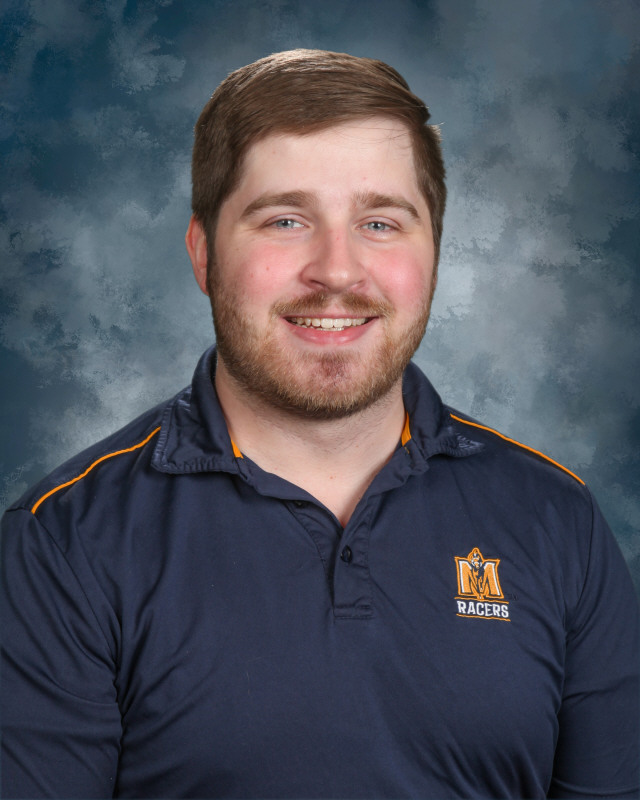
Joshua Ratsch, U.S. history teacher, grew up in Illinois, where his passion for history originated. This passion caused Ratsch to pursue teaching history, where he wants to inspire kids to think beyond the past and make connections from then to now.
There’s a lot of variety in history between different regions, time periods, and people, and there’s even more variation in why someone would want to teach it. Ratsch appreciates teaching history because it allows him to shape how students think about the world.
“I like the connections that we can make, because we see what’s happening all around us, and there’s a lot of connection to go, ‘Oh, it happened back then. This is how we reacted. This is how we turned out. How can we learn from that? How can we change going forward to not make the same mistakes we’ve made?’ The most challenging part about teaching history is getting past the belief that it’s all names and dates and memorization and boring,” said Ratsch. “I try to stress that at the beginning of the year and say, ‘Hey, I know you all think we’re just going to be doing names and dates and you’re going to have to remember, oh, Pearl Harbor, December 7, 1941 but like I said, it’s a lot more about making connections.’ It’s cause and effect. It’s why things are the way they are now compared to how they used to be back then.”
Every school subject teaches a lesson more valuable than just the face-value content. A math class might teach you how to problem solve, an English class might teach you to think critically about text, and Ratsch believes history teaches students to recognize patterns in life.
“There’s a Mark Twain quote, I think it’s at least attributed to him. It says, ‘History doesn’t repeat itself, but it rhymes.’ History, it’s sometimes called cyclical, in that you know where we are now is where we’ve been several times throughout history. And so, it’s just about knowing why things are the way they are, but also, how can we change moving forward? What can we learn to make sure that history doesn’t repeat itself, even if it looks really, really, really similar,” said Ratsch.
Beyond his drive for teaching, Ratsch has a deep passion for history that came before teaching. He attributes this enthusiasm to his birth town and constant exposure to a specific historical figure.
“I grew up in Springfield, Illinois, which is where Abraham Lincoln is, not originally from, but where he’s famously from. I went to his museum a lot growing up. We [also] took a trip when I was going into fourth grade out to Gettysburg, Pennsylvania, and so those two things kind of started the spiral that really got me here,” said Ratsch.
Moving across the country is a unique experience for many, with a variety of reasons for the move and trials on the move one can have. Ratsch finds his move from Illinois to Texas was as easy as it could be.
“My wife, her dad, took a job down here. They moved during Covid, in 2020, and then she graduated, and then I graduated. A year after we got engaged, we got married, and moved down here. It helped that I didn’t have to move, get married and then move again,” said Ratsch.
There are more difficulties to moving thousands of miles away than just the move itself. There are countless differences between states on opposite sides of the country which can make someone homesick. Ratsch has struggled slightly with adjusting to certain parts of Texas.
“I miss snow, like good snow, just because we don’t get that down here. It’s really thin and powdery. Obviously, I’ve got a lot of family up there still who I haven’t seen in several years, so that’s kind of tough, but we try to make it home when we can to see at least my parents and sometimes my grandparents. Traffic’s a big [difference], just because in Illinois I go, ‘Oh, I’m going across town. I’m going 15 minutes to go to the mall or go to a restaurant or something,’ and now the thought of driving 15 minutes in Fort Worth just fills me with pure dread,” said Ratsch. “How much there is down here and how quickly it’s expanding is different, because my in-laws live up in Keller and going on Google Maps and looking at 2020 versus now, there’s all of the [new] shops, all of the [new] restaurants, all of the [new] homes. Everybody’s leaving Illinois right now, and so seeing [how many] people are here and that it’s expanding is different.”
Not everything is different though as certain customs carry across America. Ratsch believes the main similarity he’s found between Illinois and Texas is thanks to his unique upbringing.
“There’s this belief that Texans are uniquely kind, and I grew up in a small enough town in Illinois, and so I experienced that growing up, but seeing it on a larger scale is a little bit different. I see a small town, but amplified to a much larger extent than where I’ve ever lived before,” said Ratsch.
Despite all the challenges and differences, Ratsch has found a true appreciation for Texas since moving. So much so that he doesn’t consider moving back to Illinois an option.
“I love a lot of things about Texas that I don’t really want to give up, and Illinois doesn’t have enough redeeming qualities for that. I like the temperate winters. It was 85 degrees on Christmas last year and I love it. I mean, it’s better than [Illionois.] I remember a couple Christmases ago in Illinois, the wind chill was like -45°. I love the food, and the people down here are awesome. It’s a great place to be. I don’t know if we’ll ever consider moving out of Texas, just because it’s kind of home now,” said Ratsch.
Being a history buff, Illinois native, and passionate teacher, Ratsch has a unique perspective on life which offers another level of enrichment in his lessons. It’s through that enrichment he urges students to think about history through a lens of now, rather than a lens of then.